
#335: The Basement Tapes
Revisiting Rolling Stone’s “500 Greatest Albums of All Time” (2020)

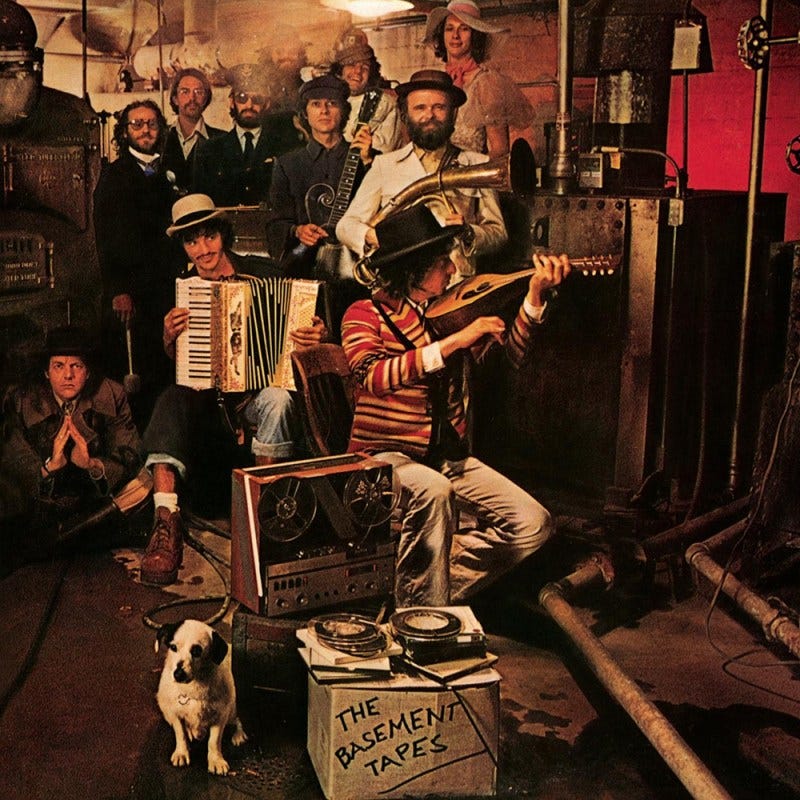
In 2020, in the depth of the pandemic, I took on a project of reviewing all 500 of Rolling Stone’s “500 Greatest Albums of All Time.” It was an excellent distraction from the state of the world at the time. I am making my way through the list again, from #500 to #1, this time sharing my reviews of each album.
Bob Dylan and The Band, 1975
These were the most famous bootlegs in history until the official release in 1975. Mostly recorded in 1967, it captures Dylan and The Band exploring different genres and styles and the result is a mishmash of songs, some brilliant, some clearly demos, and some that would go on to be recorded in another form. This is not strictly speaking a Dylan album - it is a true collaboration of the artists, with most songs shared and some from just The Band. Some were intended for The Band’s debut album, and some appeared on later Dylan releases.
Of the 24 tracks, 16 are from Dylan with The Band during the spring and summer of 1967, and 8 are tracks from The Band (with a few written by Dylan) that were either recorded just around this period or touched up / rerecorded for the album release. This was news to me. I’ll be honest, this album was one of my least favourites in the Dylan canon, and it wasn’t until the The Bootleg Series #11: The Basement Tapes Complete was released in 2014 that I paid more specific attention. I was always a fan of John Wesley Harding, but I found the rough recording style of The Basement Tapes to be less interesting to me. As a result, I didn’t read very much about this album, and didn’t know very much about the history of the 1975 release. I assumed it was due to pressure from his fans that Dylan agreed to release them, and I assumed they were nearly complete, just unreleased. That wasn’t the case - these were true demos, and in my early days as a Dylan fan I was more accustomed to The Bootleg Series Volumes 1–3 (Rare & Unreleased) 1961–1991, 1989’s Political World, Blood on the Tracks, and Desire. By 1991, even though there were many more Basement Tapes tracks that had yet to be released, only “I Shall Be Released” and “Santa Fe” were included. I loved them both, but they were so different from the other songs on The Basement Tapes. I prefer the version of “I Shall Be Released” recorded by The Band on Music From Big Pink to Dylan’s official recording on Bob Dylan’s Greatest Hits Volume II - Richard Manual’s vocals are unsurpassed. However, the version of Dylan and Manual on The Bootleg Series Volumes 1–3 (Rare & Unreleased) 1961–1991 is my all-time favourite version, and one of my all-time favourite songs, period. Chrissie Hynde’s rendition comes a close second:
In 2007, another song surfaced: the title track of the Todd Haynes film I’m Not There. It’s a brilliant soundtrack, with “I’m Not There” from The Basement Tapes sessions and every other song covered by another artist. My favourites are “Billy 1” by Los Lobos, “Ring Them Bells” by Sufjan Stevens, “Cold Irons Bound” by Tom Verlaine, and Sonic Youth’s version of “I’m Not There,” which rivals Dylan’s in intensity. So when The Bootleg Series #11: The Basement Tapes Complete was released, I was ready for it. It’s a much different collection of songs than the 1975 release, and a much different perspective. The 1975 album seems more like an anthology, a selection of songs, one not curated by Dylan himself: Robbie Robertson, reportedly, was more involved in the remixing of the demo tapes, and re-recording of The Band selections.
Dylan had a few tracks that were released officially prior to The Basement Tapes, though re-recorded, as well: “You Ain’t Going Nowhere” and “Crash on the Levee (Down In the Flood).” “Quinn the Eskimo (The Mighty Quinn)” was also written and recorded at these sessions, but not included on the album.
For The Band, some of these songs become featured on their official releases, such as “Tears of Rage” and “This Wheel’s on Fire.” In 1975, The Band were without an album of new material since 1971, and coming apart at the seams. Aside from Robertson and Garth Hudson, the other members were engulfed in addiction and depression. The Basement Tapes was released in June 1975, and their last album with the original lineup of new material would come out in November, all songs written by Robertson. They would produce one more masterpiece: The Last Waltz, a concert film and album, recorded in 1976 and released in 1978, documenting the end of The Band. Indeed, while The Band continued on sporadically in the 80s and 90s, it was without Robertson. It’s a brilliant concert film and soundtrack, with all-time performances from Van Morrison, Neil Diamond, Neil Young, Joni Mitchell, Eric Clapton, and Dylan, along with others. But in 1975, The Basement Tapes may have been just as much an incentive for Robertson as for Dylan, as it allowed him to give The Band another push forward.
David Kinney’s extensive 2014 book The Dylanologists: Adventures in the Land of Bob is a fascinating look at the most intense followers of Dylan, and Dylan’s relationship with his fans. Because The Basement Tapes existed within the industry as publisher demos for other artists, then as a rumour among fans, and finally as 7 tracks of the most famous bootleg in history, Great White Wonder, the period of Dylan bootlegs and concert recordings spawned in this era. Dylan didn’t tour again until 1974, and his fans were ravenous for something new from him. Kinney captures some of the perspectives from collectors during this time, hunting down supposed recordings or past concerts. There was always the hope that there was another Basement Tapes lurking in a box somewhere.
I guess that’s why, to me, it took so much longer to warm up to this album. I’ve always felt that the mythology and potential of this album overshadowed the music itself - for fans, a chance to hear Dylan perform songs in their infancy was to learn about the man himself, almost hearing secret recordings that weren’t meant for public consumption. Of course, that’s exactly what they were, and the reaction was suitably superlative.
Listening to this album now, in conjunction with the rest of the recordings, is a completely different experience. It’s almost as if I needed to learn the ropes of both Dylan and The Band before this would click. I am now a much bigger fan of Dylan’s early albums, and of John Wesley Harding, of Self-Portrait, of Time Out of Mind and “Love & Theft,” of “Brownsville Girl” and “Every Grain of Sand,” of Pat Garrett & Billy the Kid, and of the Manchester Free Trade Hall concert. I needed to know all of these before the secrets of The Basement Tapes were revealed to me.

My favourites now are “Goin’ to Acapulco,” “This Wheel’s On Fire,” “Open the Door, Homer,” “Tears of Rage,” “Nothing Was Delivered,” and, of course, “You Ain’t Goin’ Nowhere.” Of The Band tracks, “Long Distance Operator” and “Katie’s Been Gone” stick out to me, and would have been fine inclusions on any of their studio releases. I much enjoy this album now, having more patience than in my younger days, understanding more about Dylan and The Band than I did before.
This album is a fantastic piece of modern Americana, as much a part of American musical history as Anthology of American Folk Music. It’s also a vital piece of Bob Dylan folklore, closing a period of wild creativity and searching between 1967-1973. All of the recordings in this period are part of a suite for Dylan, and seem to flow from one into another. As I wrote in my piece on John Wesley Harding, the albums prior to this period, and following, are separate creative endeavours, Dylan moving quickly beyond an idea that sparked an album:
His move into more of a country style starts here and ends with Pat Garrett & Billy the Kid in 1973. In 1974 he goes back on tour with The Band, and in 1975 he documents his failed marriage on Blood On The Tracks, and each year after that brings a changing musical style. The period between 1967 and 1973, therefore, is probably his most sustained when it comes to style until probably the 2010s when he released three successive albums of American standards. After 1973 he goes back to constant movement; even the Christian rock period of 1979-81 isn’t as sustained as this, though it was such an abrupt turn it must have seemed like forever to some fans.
I am fully immersed in Bob Dylan these days, drawing links across his entire catalogue, from “House Carpenter” to “Key West (Philosopher Pirate).” The Basement Tapes fits into this tradition, becoming the glue that holds this period together, and adding to the myth of Bob Dylan that has grown exponentially since then. I am delighted that I keep learning about Bob Dylan with each re-listen. And with each year I hear more in every song, lines that passed me by when I was 22, suddenly catch my ear when I’m 47. With each year, I become more of a Bob Dylan fan.


A great write-up of what is arguably Dylan's greatest period (among several greatest periods). The Complete Basement Tapes are a commitment to be sure and one worth making, but I imagine you have to already be a pretty big Dylan fan to make the effort. It's such a gold mine though.
As for The Basement Tapes, Goin' to Acapulco is so beautiful (poor Rosemarie), Bessie Smith is great, and Yazoo Street Scandal is a standout which does not sound like The Band at all to me. Not sure what is going on with that one. This Wheel's on Fire is one of the best things they did together, I think.