
#337: John Wesley Harding
Revisiting Rolling Stone’s “500 Greatest Albums of All Time” (2020)

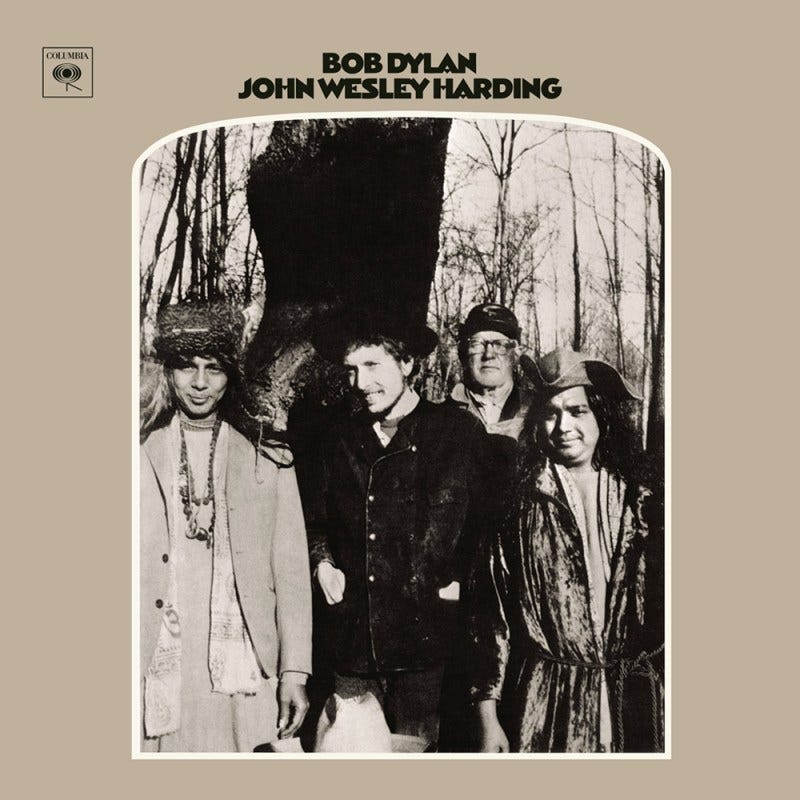
In 2020, in the depth of the pandemic, I took on a project of reviewing all 500 of Rolling Stone’s “500 Greatest Albums of All Time.” It was an excellent distraction from the state of the world at the time. I am making my way through the list again, from #500 to #1, this time sharing my reviews of each album.
Bob Dylan, 1967
First of all, a disclaimer: there has been so much written about Bob Dylan in this period (as in any period). I can’t possibly add anything new, nor can I cover all of the critical work and history of this album. I’ll make observations of my own, and if they are similar to ones that have already been made, it’s an honest coincidence.
This one is a modern folk album, with tales of vagrants and martyrs, and parables of good and evil - it might even be dubbed “Americana” if it were released 20 years later. It’s a great album - just a quiet, Nashville-style folk album that ties in very nicely with the music he was making at the same time with The Band. But the odd thing is that of the nearly 140 tracks he cut with The Band at Big Pink in the spring and summer or 1967, none of them made it to this album. As one friend of mine observed, he records a career’s worth of tracks with The Band and the skips off to Nashville without them to record 12 brand new tracks in a completely different style. His backup this time was Kenny Buttrey on drums and Charlie McCoy on bass, a veritable hall of fame trio. They had both worked with him on Blonde on Blonde a year and half earlier, and are superb across each and every second of this album.
The thing about this album was that it was his first release after a horrific motorcycle accident in 1966. It dropped in late December 1967, hardly a prime window for a commercial release. It’s like he was hoping to stay under the radar. It’s quite a departure from the chaos and circus surrounding Blonde on Blonde, including the notorious world tour where he and his band were booed for playing electric - he was backed up by The Band before they became The Band - so much so that Levon Helm left the tour. So Dylan releases 6 monumental albums in 4 years, changes music and culture in the mid-60s, and then disappears for 18 months while recuperating. He comes back with this album that challenges the expectations, and then follows it up with a country album, Nashville Skyline, and then a strange collection of standards and live tracks called Self-Portrait, famously prompting Greil Marcus to remark, “What is this shit?;” now no one knows what to expect from Dylan, which was his goal all along - he is back to the mysterious, enigmatic persona he envisioned a decade earlier. But it all starts with his disappearance from the public eye and the return with John Wesley Harding.
The album starts with the title track. It’s a modern folk tale, a legendary figure bringing justice and truth to the underserved, albeit forcefully. Here, I feel, Dylan injects his own vision of himself into the title character:
And there was no man around
Who could track or chain him down
He was never known
To make a foolish move
Though I don’t think Dylan would ever say he never made a foolish move, I imagine that he would like his listeners to think this was the case - a sort of pre-emptive reassurance that he knows what he’s doing. Over time, he has proved this to be true, as seemingly odd choices have turned out to be a master stroke of insight and creativity. Of course, they’re not all genius moves - the “We Are The World” clips are proof of that - but at nearly every turn, Dylan’s instinct for musical innovation has been fruitful. In this period, the sessions with The Band that came to be The Basement Tapes created the foundation for John Wesley Harding; even the scattershot 2-LP collection that is 1970’s Self-Portrait created the environment that would culminate in Blood On The Tracks a few years after that. And, certainly, he was not one who could be tracked or chained down.
The Bootleg Series Vol. 10: Another Self-Portrait, released in 2013, is an excellent collection that shows what the vision was: even though there was a disconnect between what was recorded and what was released, I feel the Self-Portrait is unfairly dismissed: there are some gems. If he had released a single disc of original compositions, like studio versions of “Minstrel Boy” and “Quinn The Eskimo (The Mighty Quinn)” and traditional covers, such as “Pretty Saro” or “Copper Kettle,” it would have fit well between Nashville Skyline and New Morning. But I’ll never understand why he would release covers of contemporary songs like “The Boxer” or “Early Mornin’ Rain” - there was no need, as he was already one of the most covered artists in history by this time.
The second track is “As I Went Out One Morning.” This one is a minor song in his canon, but it’s an intense vision. One can imagine that he’s contemplating his time away from the public eye and the suspicions he retains:
I offer’d her my hand
She took me by the arm
I knew that very instant
She meant to do me harm
It’s around this time that while he retreated to Woodstock to recuperate from his injuries, fans constantly sought him out. He had a young family and still moved a few times to avoid these encounters. While it’s hard to imagine that anyone wished to do him specific harm, he still found that fans would break into his house while he was away.
It’s here that I noticed the number of first-person song titles. Dylan is often uses first person perspective, and always sort-of singing about himself, but usually it’s cloaked in metaphor and characters, like “Napoleon in rags,” or in second-person perspective. His earlier songs, like “A Hard Rain’s Gonna Fall,” have vague perspectives: “Oh, what did you see, my blue-eyed son?” could be someone talking to him, or him asking the question. And while the answer is in first person, it could be the narrator relaying what he heard or it could be him providing the answer. On Blonde on Blonde, “Just Like a Woman” shifts from the narrator singing about a woman - “She makes love just like a woman” - to addressing her in the last verse: “When we meet again / Introduced as friends / Please don’t let on that you knew me when.” On John Wesley Harding, five of the twelve tracks contain “I” in the title, and there is a sense that he singing more directly than on prior albums, despite the parables and folk tales.
He’s written himself into songs before. “Bob Dylan’s Dream,” from The Freewheelin’ Bob Dylan, is a mournful reflection on the changing times. It’s a wish rather than an actual dream. On “Bob Dylan’s 115th Dream” from Bringing It All Back Home, he inserts himself as directly as one can in a song. But it’s a dream, and a farce, removed from any responsibility to reality. Now, on the third track of John Wesley Harding, “I Dreamed I Saw St. Augustine” sounds more real. It’s an apocalyptic vision and there are sections where he genuinely sounds afraid:
I dreamed I saw St. Augustine
Alive with fiery breath
And I dreamed I was amongst the ones
That put him out to death
Oh, I awoke in anger
So alone and terrified
I put my fingers against the glass
And bowed my head and cried
It’s a heartbreaking ending.
“All Along The Watchtower” is the most famous song on this album, though I feel that it’s not the best version of it. The tension and thrill of the story can be summed up in one line: “Two riders were approaching, and the wind began to howl.” Dylan tries to match this with wild abandon but it’s not as effective as Jimi Hendrix’s version several months later: Hendrix makes his guitar howl. It’s not by coincidence that Dylan himself uses Hendrix’s arrangement on tour after that; and it was no accident that Neil Young used Hendrix’s version to salute Dylan at the 30th Anniversary Concert (Young comes close to hitting the full effect, as his voice actually howls when he sings that line). But here, Dylan’s trio can’t quite let loose enough for this song to really hit home. Buttrey and McCoy are one of the most creative and crisp rhythm sections he plays with, but this song calls for power, and they’re about precision.
“The Ballad of Frankie Lee and Judas Priest” is one of my all-time favourite Dylan songs. The simple arrangement and repeating three chord structure from Dylan is entrancing. It doesn’t change throughout - there’s no verse-chorus-verse structure, it’s a parable with no repeated lines, letting the arrangement provide the consistency. It’s the first one of Dylan’s songs that I remember hearing that would be just as good without the vocal track - heresy from a Dylan fan to imagine a Dylan song without lyrics. But those three chords are intoxicating, the melody carried by his voice and a short harmonica interlude. The tale is cloaked in metaphor and not easily extracted, unless you start to apply a theory, such as Dylan’s displeasure with his current manager, Albert Grossman, to the narrative. Otherwise, the piece of advice dispelled is somewhat simplistic with profound meaning:
Well, the moral of the story
The moral of this song
Is simply that one should never be
Where one does not belong
He says “simply” but it’s not so simple to follow if you don’t know when you don’t belong. Dylan is providing insider knowledge, an “IYKYK” 40 years before it became a thing.
“Drifter’s Escape” is perfectly in their wheelhouse. The backbeat is crisp and steady, and Dylan’s constant acoustic defers to McCoy’s active bass line, and Buttrey’s drumming is absolutely stunning. Dylan’s harmonica comes in at the end to mimic the escaping drifter.
“Dear Landlord” features Dylan on piano this time with bass and drums. McCoy and Buttrey are perfect once again, and Dylan’s vocals are excellent. There’s two lines here that convinced me that he’s trying to tell his fans (and critics) something: first, there’s caution against wealth:
All of us, at times, we might work too hard
To have it too fast and too much
And anyone can fill his life up
With things he can see but he just cannot touch
And then there’s another peek into Dylan’s mind about what he’s about:
Now, each of us has his own special gift
And you know this was meant to be true
And if you don’t underestimate me
I won’t underestimate you
Here, I imagine he’s snarling at his critics, who constantly underestimate him, and his anger simmering underneath. This brings to mind “Ballad of a Thin Man,” not just because of the prominent piano, but because it was famously aimed at a journalist: “Because something is happening here / But you don’t know what it is / Do you, Mister Jones?” He’s underestimating and undermining his subject because he himself is underestimated; perhaps if the journalist gave him more consideration, Dylan would respond in kind. This is true of many of Dylan’s colleagues and former colleagues, and Dylan does not suffer fools. He has no time for anyone who does not feel that he will do things other people can’t do. This may be why he turned down the Woodstock festival and played The Isle of Wight Festival in the summer 1969 instead. It was nearly literally in his backyard yet he went as far away as possible, specifically to avoid being associated with a massive festival promoting peace and love. It seems that he did not want to do anything because it was expected of him, specifically because it was expected. To me, this line speaks to this reaction - if you feel he would do the thing that other people would do, you’re underestimating his vision.
“I Am a Lonesome Hobo” is Dylan stating nearly the opposite of what actually exists for him. Or perhaps it’s a worst-case scenario for him, a situation where he can’t pursue the creativity that propels him. In the first verse he states, “Where another man’s life might begin / That’s exactly where mine ends” when, of course, it’s the opposite - his life begins at a point which is nearly unfathomable for most people. He’s purposely distorting his own reality, if you take him at his word. But he also dispenses advice from this perspective, which is another recurring theme on John Wesley Harding - rather than create tall tales or social commentary as an outsider, he creates a character inside the affected situation and tells people what to avoid. In “I Am A Lonesome Hobo,” he has words of warning:
Kind ladies and kind gentlemen
Soon I will be gone
But let me just warn you all
Before I do pass on
Stay free from petty jealousies
Live by no man’s code
And hold your judgment for yourself
Lest you wind up on this road
“Live by no man’s code” is a telling line - he’s revealing, once again, the truth behind what he expects from his fans and critics. He lives by no man’s code, and anyone expecting anything of him will be disappointed. In this, I draw a parallel to his fellow Minnesotan, Prince - almost every aspect of Dylan’s view of the creative mind applies to Prince. He would routinely push against any expectation placed on him, and it would routinely result in a work of creative genius that no one could imagine prior to him doing it. He certainly took this advice to heart - while he did not live completely free of petty jealousies, he certainly held his judgement for himself.
Musically, “I Am A Lonesome Hobo” is miraculous. Dylan’s singing is impressive, but he’s keeping up with McCoy and Buttrey on this one. Buttrey’s drumming is one of the most dynamic and impressive pieces of instrumental accompaniment I have heard. He keeps adding things with each section, a double hit here, a roll there, all the while keeping up an impressive tempo, matched only by McCoy’s dancing baseline. Dylan’s acoustic keeps the rhythm while the other two provide the magic.
“I Pity the Poor Immigrant” is a strange tune from Dylan, a slow ballad that, seems to me, is in the Woody Guthrie tradition. The only line that turns it from a folk tale to a personal regret is in the middle stanza: “Who falls in love with wealth itself / And turns his back on me.” I am not sure I can interpolate what Dylan really means here by “Immigrant” - I am sure it’s not simply a commentary on America’s domestic policies. I think it’s more like a person who is somewhere where they do not belong, like a non-musical person in the music industry, or a journalist who is too big for their britches. It seems to me Dylan, by including that line, narrows it to a personal grievance.
“The Wicked Messenger” is another parable of false tales and archetypes, and the last two tracks are “Down Along Cove” and “I’ll Be Your Baby Tonight.” These two are unlike the rest in that they feature Pete Drake on pedal steel and they are quite straightforward love songs. It’s almost like he realized that the other 10 songs carry some heaviness, and these two are lighter fare. “I’ll Be Your Baby Tonight” is also foretelling of his next creative impulse, a country-rock album in Nashville Skyline. That album, made up mostly of relationship songs, would accommodate this track easily. There’s “To Be Alone With You,” “Tonight, I’ll Be Staying Here With You,” and “Lay Lady Lay,” his most well-known song about, well, let’s call it “love.”
His move into more of a country style starts here and ends with Pat Garrett & Billy the Kid in 1973. In 1974 he goes back on tour with The Band, and in 1975 he documents his failed marriage on Blood On The Tracks, and each year after that brings a changing musical style. The period between 1967 and 1973, therefore, is probably his most sustained when it comes to style until probably the 2010s when he released three successive albums of American standards. After 1973 he goes back to constant movement; even the Christian rock period of 1979-81 isn’t as sustained as this, though it was such an abrupt turn it must have seemed like forever to some fans.
John Wesley Harding is a lesser-known Dylan album, yet ironically containing, arguably, his most well-known song in “All Along The Watchtower.” “All Along the Watchtower” and “I’ll Be Your Baby Tonight” are the most commercial tracks, both of which appear on 1971’s Greatest Hits Vol II. I would argue that there are 3 songs better than those on this album, in “The Ballad of Frankie Lee and Judas Priest,” “I Am A Lonesome Hobo,” and “Drifter’s Escape.” yet they are so specific to this period of time that they don’t easily work outside of the album’s context. Indeed, according to bobdylan.com, he’s never played “I Am A Lonesome Hobo” in concert; he’s played “The Ballad of Frankie Lee and Judas Priest” only 20 times, while “Drifter’s Escape” is played most often at 256 performances, yet only starting in 1992, and last played in 2005. In contrast, he’s played “All Along the Watchtower” 2377 times since 1974, and the last time was this past June (he also last played “I’ll Be Your Baby Tonight” in 2026, though only 711 times total). I mean, he’s got thousands of songs, so it’s not that surprising that some don’t make the cut, but it’s telling that these three, so perfectly performed on this album, don’t translate outside of this context.
All of the years of Bob Dylan’s career are fascinating for one reason or another. But 1967 captivates fans and critics most intensely, specifically because he was hidden from view, and The Basement Tapes existed only as 7 tracks of a 24-track bootleg called Great White Wonder (the cover was plain white) until its formal release in 1975. When he finally emerged in December 1967, he did not disappoint. Fans would never underestimate him again.


I adore this album very much, and I hate that casuals end their Dylan journey at '66. This record feels so important to, not just Dylan's discography, but popular music in general: it set the model of who to do a retreat away from where critics were expecting you to go and do what you want to do - and do it perfectly. Buttrey and McCoy might be the greatest unsung rhythm section ever, they never miss a beat here.
I disagree with what you said about Hendrix's version of "Watchtower" besting Dylan, though I understand that's a hot take. Hendrix's version feels like a different song (which is fine), but it also makes comparing them completely moot.
I really enjoyed this (and any opportunity to read a thoughtful piece about Dylan's work). Coincidentally, it was Dylan who inspired me to do a similar dive into the 500 greatest albums (though I didn't write about them and listened to them out of order for no good reason).
This is such an interesting album, and it's impossible to appreciate what a jolt it must have been when it came out after the 3 that preceded it.
You make a great point about all the work he did on the Complete Basement Tapes only to exclude any of the songs on here, but I do think there are a lot of similarities in the biblical themes and the stripped down arrangements after the frenzied performances of the previous few years.
Making an album of virtually no choruses is one of 1000 ways that he has shown his vision and willingness to experiment.