
#411: "Love & Theft"
Revisiting Rolling Stone’s 500 Greatest Albums of All Time (2020)

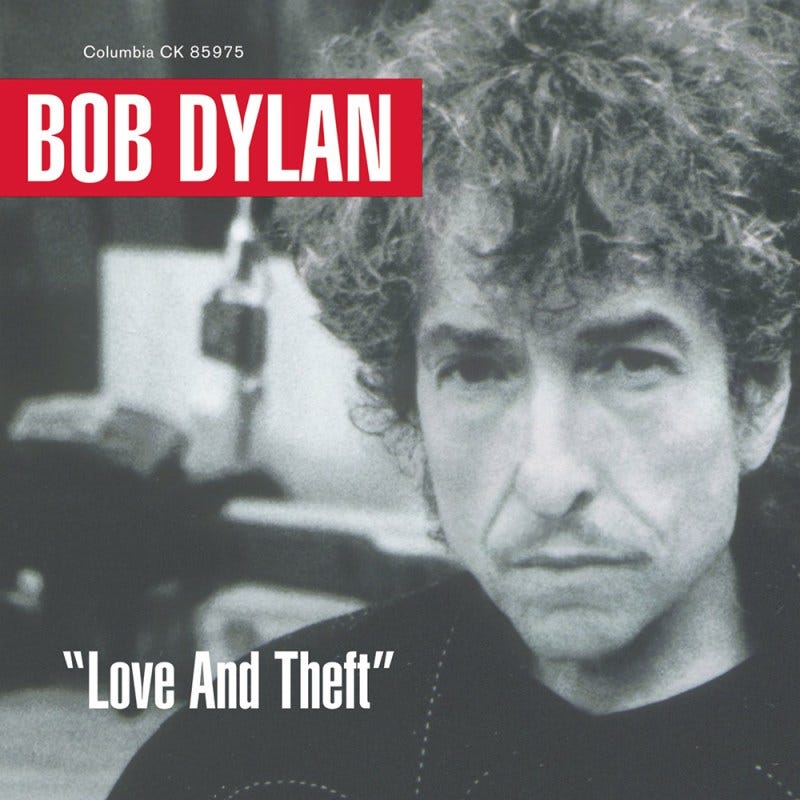
Bob Dylan, 2001
This album is a prime example of Dylan's late career brilliance. The centrepiece is the fantastic “Mississippi:” it's one of his best, and considering that he has only himself as competition, that's saying something. There are several other gems on this album: “Summer Days,” “Lonesome Day Blues,” “Moonlight,” “Cry a While,” “Honest With Me.”
It's a great listen all the way through, and his band is absolutely amazing, as he uses his travelling troupe and they're really tight, just great, precise musicians. If you've seen him in concert in the last 20 years, you know what I mean - they wear matching suits and just go to work on stage. He has not, however, become a better vocalist with age. Here though, having just turned 60, he leans in quite heavily to this 21st century rasp, and it works with this material - it's like old country, Hank Williams, or blues masters adjacent; but you won't confuse it for anything other than a Dylan album. “Love & Theft” is a country-ish, blues-jazz album, an American folk classic for the 21st century.
His earliest entry on this list is The Freewheelin' Bob Dylan (#255) from 1963, making it 38 years between earliest and latest, which is incredible.
I could write for pages about this album, but there are four songs that really deserve extra attention: “Mississippi,” “Floater (Too Much to Ask),” “High Water (For Charley Patton), and “Po’ Boy.”
“Mississippi”
This is easily one of the best late-Dylan songs, and possibly one of his best all-time songs. It has its own history behind it: he wrote it for the Time Out of Mind sessions but couldn’t quite get what he wanted with Daniel Lanois’ production, and he shelved it, but not before recording several versions. In the meantime, Sheryl Crow recorded a version of her own, and The Chicks released a live version based on Crow’s arrangement (in my opinion, the Chicks really do the better version - “Mississippi” is a country song, after all). The version that’s released on “Love & Theft” is better than all the rest, however. He produced the album himself this time and used his own band, making for a flawless rendition. Lyrically, it’s as evasive as ever, though there’s more emotion in his singing on this song than on others on the album, as though here the narrator is closer to Dylan himself, while the other songs are more character sketches. This is also why the cover versions don’t particular pack the same punch - there is an emotional detachment to the cover versions, whereas Dylan pours something extra into his performance. The refrain of “Only one thing I did wrong / Stayed in Mississippi a day too long” is a Coen Brothers movie waiting to happen.
“Floater (Too Much to Ask)”
This one has become my favourite. The lyrics are organized in quatrains, completely, or seemingly, unrelated. He comes back to this mechanism a few times throughout this album, and the stanzas are only tied together by feeling, as though you are learning about the narrator piecemeal through random facts. In “Floater,” the best lines are the ones that surprise you, even though you’re expecting to be surprised:
A summer breeze is blowing
A squall setting in
Sometimes it’s just plain stupid
To get into any kind of wind
And
One of the boss’s hangers-on
Sometimes comes to call at times you least expect
Try to bully you, strong-arm you, inspire you with fear
It has the opposite effect
And
They all got out of here any way they could
Cold rain can give you the shivers
They went down the Ohio, the Cumberland, the Tennessee
All the rest of them rebel rivers
But then he throws in an ominous line, like the chaos agent he is:
If you try to interfere with me or cross my path again
You do so at the peril of your own life
I’m not quite as cool or forgiving as I sound
I’ve seen enough heartache and strife.
The thing is, he doesn’t sound “cool and forgiving” at all.
His first album was released in 1962, and he last released an album in 2023, making it over 60 years of recording. That's also incredible.
“High Water (For Charley Patton)”
This one is more ominous, with a voice that has definitely experienced heartache and strife. Charley Patton was an early 20th century blues pioneer, who some say was instrumental in the birth of the blues to begin with. “High Water” is inspired by Patton’s “High Water Everywhere,” about the Great Mississippi Flood of 1927. The refrain in this one is some variation on “It’s rough out there / High water everywhere.” It’s a driving, dark blues song, sung as a warning while also providing a key to the album as a whole. If you start connecting the dots between these songs and blues and American folk classics, you’re starting to make progress. Dylan will guide you the rest of the way.
“Po’ Boy”
“Po’ Boy” is a delightful, moving tune, more on the jazzy side than blues. It’s somewhat connected by a “Poor boy” refrain, and each stanza seems to be connected by misfortune or cluelessness. However, there’s one stanza that is very straightforward and only lifted by the delivery:
My mother was a daughter of a wealthy farmer
My father was a traveling salesman, I never met him
When my mother died, my uncle too me in, he ran a funeral parlor
He did a lot of nice things for me and I won’t forget him
If you read it straight, it’s a nice sentiment, but hearing Dylan pause ever so slightly after “I” and “won’t forget him” is enough to bring you to tears. When I first bought this album I was not yet grown, and couldn’t understand; now, 25 years later, I am a parent, and, well, now I do.
This album ages so well because it was already timeless the day it was released. It is 21st century music from a 20th century icon drawing upon 200 years of tradition. And Dylan lets you know that you’re in for an experience right off the bat in “Mississippi:” “Stick with me baby, stick with me anyhow / Things should start to get interesting right about now.” It goes without saying that this one has been in my library since it came out.
This was my gateway Dylan album.'Tweedle-Dum and Tweedle-Dee' is for sure in my all-time top 20 Dylan songs,and 'Po Boy' was wistful without sinking into bathos.Then,too,his sense of humor is deployed to great effect throughout the album.Yes,great band.Charlie Sexton is right up there with Mike Bloomfield,just as Augie Meyers channels Al Kooper.Well, that's what it sounds like to me,anyway.Side note:I wish he'd continued his Radio Theme Time Hour.The man knows his s***,and his memory is astounding.I could see someone like,say,Marshall Crenshaw picking up the gauntlet and continuing with that concept.Looking forward to reading your next 'second look'.Cheers!
The comment about being a Coen brothers plot is spot on! Great song, great album.