
The Next 500 #43: Will The Circle Be Unbroken
The Next 500 Greatest Albums of All Time

Over the course of reviewing albums on both “The 500 Greatest Albums of All Time” and “The 250 Greatest Albums of the 21st Century So Far,” I have found that some albums aren’t receiving the recognition they deserve. I decided to showcase my personal picks for some of the greatest albums of all time in a series called The Next 500. These are some of my favourite albums of all time not represented otherwise.
Nitty Gritty Dirt Band, 1972
I am still having an ongoing conversation with country music. It started when I first heard Dylan’s Nashville Skyline as a teenager, unsure about what was happening with the same artist who gave me “Tangled Up in Blue” and “Most of the Time.” Of course, I was familiar with Kenny Rogers and Dolly Parton and Willie Nelson and “Ring of Fire,” but it wasn’t until much later that I appreciated Red Headed Stranger and At Folsom Prison and both versions of “Me and Bobby McGee.” These were all friends of Bob Dylan and I had seen them perform on a PBS broadcast televising the 30th Anniversary Concert for Dylan in 1992 (or, as Neil Young dubbed it, “Bobfest”). Kris Kristofferson was MC, Nelson and Cash and June Carter Cash performed, along with dozens of others celebrating Dylan’s music. It showed the versatility of Dylan’s songs, but also of country music performers. Looking at Dylan’s songs in particular, which have been covered by artists from all genres, and quite frequently by country artists, it’s notable that country performers have connected with his music, much in the same way R&B performers of the 60s connected with The Beatles.

Dylan’s folk beginnings and subsequent ongoing connection with Nashville and country music, all the way up to and beyond 2001’s “Love and Theft”, shows country music’s roots, too - Hank Williams, the Carter Family and others sounded much closer to Woody Guthrie and other folk artists of the 50s and 60s than it does today. Country music wasn’t really a separate genre until rock & roll started to rise; it may have been Elvis’s failed Grand Ole Opry appearance in 1954 that sealed the deal in separating rock & roll and country for the rest of the century. In the 21st century, Americana acts like Gillian Welch and Alison Krauss follow in Lucinda Williams’s footsteps in reuniting country and rock music.
In the late 60s and early 70s, along with Dylan’s excursions into country with Nashville Skyline and Self-Portrait, there was a bit of a country-rock exploration. The Byrds, Gram Parsons, Grateful Dead, and Neil Young all recorded in Nashville or embraced a countrified rock sound (there are many other examples, of course, but these were in my orbit). And then there was The Allman Brothers Band, whose mix of blues and country rock necessitated a new designation called Southern Rock. It was very close to an outlaw country sound and had fans across both genres; though not country enough for country purists, it’s close enough for rock fans.
In the 80s, the gap got wider as the Nashville machine started creating an industry rather than just a close-knit community. Country music became a commercial powerhouse, with Alabama and Kenny Rogers and “Fishin’ in the Dark” competing directly with mainstream rock for the first time. By the 90s, Garth Brooks and Alan Jackson fortified the ever-widening gap between rock and country. Crossover hits like“Friends in Low Places” and “Chattahoochee” were welcome bonuses, but not the goal (Shania Twain, being Canadian, didn’t really subscribe to all that genre stuff and just made pop music).
Through all of this, country music was on the periphery for me. My folks did not listen to it so I didn’t either. Friends who had Garth Brooks’s Greatest Hits were curious outliers amid my hip-hop friends and indie rock friends. It didn’t take hold for me, though I never rejected it in the way some rock absolutists might. One summer during university I had a job where the truck radio played talk or country, and so I listened to country, and if you listen to country music all day every day for a few months, you’ll understand it; modern country is a pop music machine the way classic rock radio is a commercial machine; AC/DC and Brooks & Dunn aren’t that much different when you get down to it, and neither are Taylor Swift and Kasey Musgraves.
All of this was part of my experience with country music when I discovered Will the Circle Be Unbroken a few years after that. Bluegrass was not the same as country music to my ear - it was more like blues or jazz, foundational and limitless. Country music, traditional-style, sounded different to me.
Will the Circle Be Unbroken has so many layers to it, it will take years of listening before I truly understand it all. The first thing I realized about this album is that country music is a foundation as crucial to modern music as blues or folk. It’s all here on this record, the real-time connection between genres. The presence of the Carter Family, specifically Mother Maybelle Carter, is sigificant, as the A.P. Carter-written title track, taken from a traditional hymn, links everything together. The other foundational music that comes through here is gospel, an element less present, though not entirely absent, in rock and roll, but vital to country music. This thread goes deep and wide over the history of the genre, all the way up to the 21st century where country “rebels” like Eric Church and Maren Morris make waves by singing about recreational drugs and general carousing. The acknowledgement of gospel and the Christian faith is as important a theme in country music as heartbreak and depression.
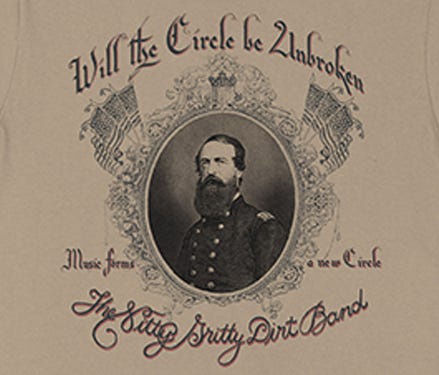
The thread that is also present is the diverging paths in which traditional music takes. Aretha Franklin sings “Amazing Grace” on her album of the same name, recorded in the same year; Joan Baez sings “Swing Low, Sweet Chariot,” and The Band takes it to a new level with “The Night They Drove Old Dixie Down.” The cover of the album features Union and Confederate flags, and a portrait of Union admiral David Dixon Porter, bringing to mind “Battle Hymn of the Republic.” It’s problematic to mingle Confederate and Union imagery, and the gap between gospel sung by white Christians and Black Christians is vast in symbolism. Will the Circle be Unbroken doesn’t address that or even alleviate any of that tension. It’s about a certain branch of traditional music, past and present.
Another layer that comes with this music is the sheer skill of the musicians involved. Listening to “Foggy Mountain Breakdown” or “Soldier’s Joy” or “Lonesome Fiddle Blues” isn’t about country or gospel or folk. The musicians are masters of their craft. You don’t need to “like” country music to appreciate what these players are putting down. For the musicians, too, it becomes a connecting point between old and young. The music of this double album goes hand in hand with the conversations in the studio that accompanies it. It was an incredible idea to record the studio chatter leading up to the recordings from the legendary artists recording with Nitty Gritty Dirt Band. It creates the community that’s always been there, especially in Nashville, among country artists. As Elvis found out, it’s a tough clique to crack; Willie Nelson, too, found more success in returning to his native Austin than trying to edge himself into Nashville. The guests that joined the California-based Nitty Gritty Dirt Band seemed to enjoy the unlikely collaboration of traditional and modern country music, and the chatter on the tracks reinforce that.
The mere collaboration between modern country artists, “hippies” like Nitty Gritty Dirt Band, and classic country stars like Earl Scruggs, Roy Acuff, and Doc Watkins is historical in itself. Bluegrass founder Bill Monroe refused to participate, though he would have fit right in on “Nashville Blues” and “Orange Blossom Special.” The most special part of this album is the last two tracks (on the original release): the title track, featuring all of the players, and an instrumental version of Joni Mitchell’s “Both Sides Now” to close the album, representing past and present together. Randy Scruggs, Earl’s son, performs a beautiful rendition of “Both Sides Now,” still intensely emotional despite the lack of lyrics. It’s a testament to Mitchell’s song, showing that, like Dylan, her music is foundational and can be translated across genres and generations. Nitty Gritty Dirt Band understood that this song represented everything they were trying to do with this album, bringing generations together who had seen both sides of everything. Nitty Gritty Dirt Band had most of their career ahead of them while Maybelle Carter, Roy Acuff, and Earl Scruggs were getting their swan song.
This album is special in many ways, though not uncomplicated. It’s an historical coming together of traditional and modern country music in an era where rock & roll was threatening to absorb country music just has it had blues, R&B and folk. It’s a timeless album, too, recreating traditional folk and bluegrass music to ensure its survival. I won’t call myself an aficionado of country or bluegrass music, and this is probably as far as I’ll go in my listening habits. I’ll keep my ears open to new country, with interesting artists like Old Dominion, Miranda Lambert, and Ella Langley making interesting music. My relationship with country is less complicated in my mind now than it was. I like what I like, and this music sparks uncomplicated joy.
Note on the cover image: I initially had the actual album cover as the image, but I decided to change it out for an updated image found on the band’s website - the merch for this album depicts two sets of the American flag rather than the Confederate flag as on the album cover. I feel much more at ease knowing that even the band realized the 1972 album cover is inappropriate in the 21st century.
Well, there is country music, and then there is country music. You are drinking from the right well.