
#413: Cosmo's Factory
Revisiting Rolling Stone’s 500 Greatest Albums of All Time (2020)

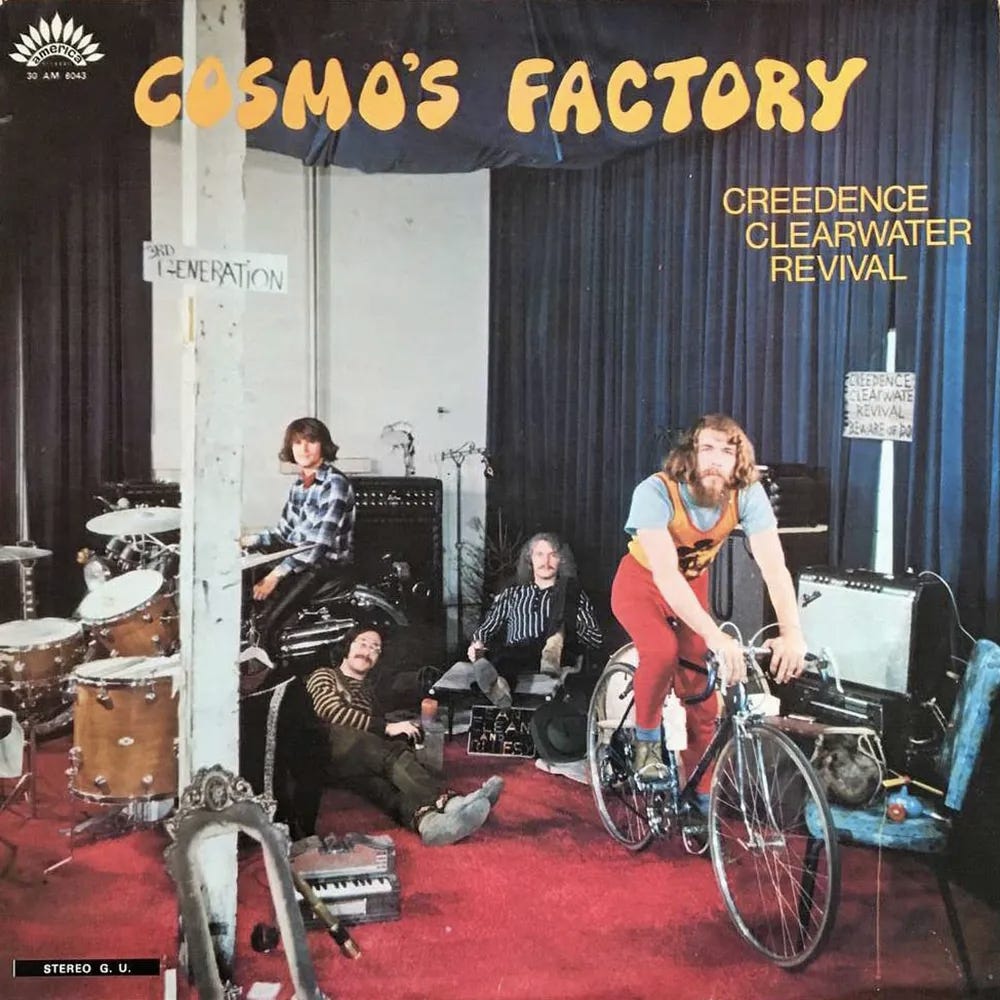
Creedence Clearwater Revival, 1970
When I was in my early teens, I had just discovered Tom Petty, thanks to Into The Great Wide Open. I had then discovered Full Moon Fever, and the “Mary Jane’s Last Dance” video was all over the tv. But I was still a Tom Petty neophyte, and one day “Here Comes My Girl” came on the radio - I was waiting in the car, by myself, and I had no one to express my utter astonishment in hearing this song. I was blown away. I knew it was Tom Petty, because how could you not, but I had not heard this fantastic song before, and I pieced it together, as I often did pre-internet, that this was the new Tom Petty song. Man! This guy knows how to write a song. I spent several days searching for this song further, but, alas, there was no music video, and my sources of information were severely limited. I was sure I would hear this song again - it’s incredible! But I did not hear it on the radio again, and I couldn’t quite remember enough to try to describe it to someone. That Christmas I received Tom Petty & The Heartbreakers Greatest Hits, and there it was - “Here Comes My Girl.” Except it was not the new song from the band, it was nearly 15 years old by that time; I had just never heard it before. But it was new to me, and my singular pursuit of finding this “new” song continually reminds me of the magic of music, regardless of when or how you come to it.
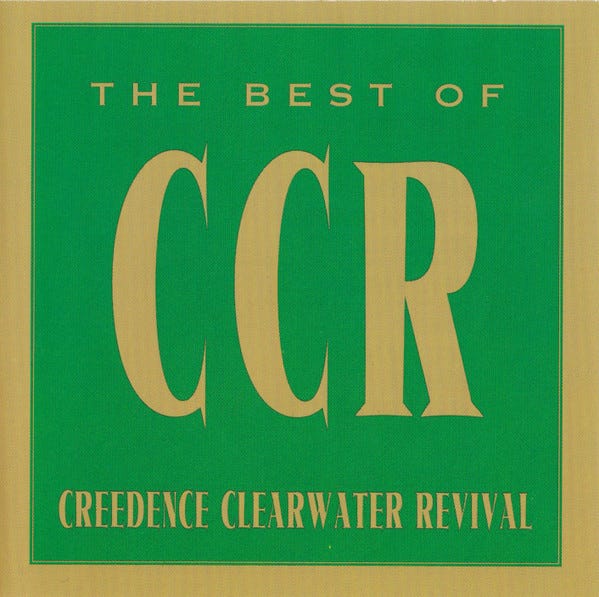
A year or so prior to that, I heard another song that absolutely blew me away. I remembered the song title: “Sunshine of Your Love.” This song was not like anything I had ever heard, and though I didn’t really know the band, I mostly remembered the band name - it had a “CR” in it, and so when it came time for letting my parents know which cd I wanted for Christmas that year, I confidently let them know that I wanted a CCR album. My parents certainly knew who CCR was, and I applaud them for following through with my wishes. If I had only continued my thought and said, you know, “Sunshine of Your Love,” I might not have heard CCR until much later. But that year, instead of Cream, I received CCR’s double disc greatest hits with that famous green cover (it was a classic double thick jewel case to boot). I was perplexed when I put this through my stereo - surely “Sunshine of Your Love” was the title, but maybe it’s actually called something else? I waited for it, but by the time I had made it through those two discs, I didn’t really worry about “Sunshine of Your Love” any longer: I was a Creedence Clearwater Revival fan, and Eric Clapton and co would have wait.
Who Are These Guys?
Cosmo’s Factory, from 1970, was as unknown to me in 2020 as they were 30 years earlier. For as much a fan as I was as a teenager, I didn’t have cash to burn on cds with half the songs already in my possession. I had Superunknowns and Vitalogys to buy. Putting on the headphones and cycling this one up and hearing “Ramble Tamble” was as incredible to me as hearing “Here Comes My Girl” all those years ago. I was surprised that I had not heard this before, and that I had not taken the time in the 10+ years of iTunes to actually check this album out. But “Ramble Tamble” was mesmerizing, a side of CCR that I did not know existed. I remember thinking “who are these guys? What is this song? Do other people know about this song?” The title is so close to “Ramblin’ Man” that I expected The Allman Brothers Band, and it’s hard to shake that still. The Allman Brothers Band was well known to me since a young age - the presence of “Jessica” during the road trip montage in Field of Dreams is seared into my brain I watched that movie so much. Brothers and Sisters was played a lot in our house, and to this day I marvel at how I could hear a song from pre-1980 and there was an 80% chance my dad would have the record (“Sunshine of Your Love” was seemingly in that other 20%).
“Ramble Tamble” is such a 1970 song. It’s bluesy and folksy, but there’s this middle section that transcends space and time, as if Lana Del Rey had written it. It’s a crazy effect, and then the band just goes back to what they were doing before, as though they took a coffee break in the middle and Brian Wilson started noodling in the studio while they stepped out. And that’s what Cosmo’s Factory is all about. This band, Creedence Clearwater Revival, seems to be one thing and then it’s another. And another. And another.
After “Ramble Tamble,” the band senses you need a break and they play “Before You Accuse Me,” a Bo Diddley song, and it’s a good effort, but it’s not Bo Diddley and that’s not the point. After “Before You Accuse Me” comes “Travelin’ Band,” showing that they’re Little Richard fans. “Ooby Dooby” is next, and now they’re just showing off, they can do psychedelic rock, blues, R&B, or rockabilly, whatever.
After these first four, the band gets into it, as though the opening part of the album was really just the opening act. From this point on, aside from one of the two remaining covers, each song that comes on invites a superlative: “This is my favourite song on the album.” Few albums can pull off this type of track listing, putting the singles deep into the back half. But John Fogerty can give two shits about your expectations; he’s about swamp rock and voodoo. “Lookin’ Out My Back Door” is a poppy little tune that is absolutely excellent before “Run Through the Jungle” arrives to knock your teeth out.
Seriously, who are these guys
Side 2 opens with “Up Around The Bend.” It would probably boast the best guitar riff that the band ever produced, but they had already released “Fortunate Son” a year earlier. After another slight detour with the cover “My Baby Left Me,” CCR comes back with “Who’ll Stop the Rain.” This one is a gorgeous song, and this must be the best song on the album, or at least the best melody, but there are still two songs left…
Growing up in the 80s, I was well aware of the California Raisins. They appeared on commercials, and were a quirky little claymation oddity that anthropomorphized California raisins into a doo-wop group. Then came the Saturday morning cartoon, and the figurines. I remember watching the cartoon, and it was pretty entertaining to a 10 year old. I can’t even imagine what the plots would be like. What would several talking raisins be able to get up to week after week? What kind of zany adventures would we witness this time? But that didn’t matter, what mattered is that they sang “I Heard It Through the Grapevine,” and once you figured out that raisins were singing about the grapevine, it didn’t much matter what they did after that.
When CCR sings “I Heard It Through The Grapevine,” they are really into it. It was by far my favourite of theirs on that green greatest hits double album, and I would skip back to it several times in a row (I didn’t have to skip back too many times, as it’s 11 minutes long). I wouldn’t know that Marvin Gaye or Gladys Knight & The Pips did it first until much later. Hearing it here, on Cosmo’s Factory, it still fits the bill as the next great song, and, unlike the other covers on this album, it doesn’t try to match the vibe of the earlier artists - it strives to be on its own, with scruffy California musicians soloing and jamming their way through until it finally gets to be a CCR song more than a Marvin Gaye song. That being said, it’s more like it’s two different songs that share the same name: they couldn’t be more different. It’s got the iconic bass line, but CCR adds a dankness to it, crawling up from the Louisiana swamp or something, harkening back to their earlier cover of “I Put a Spell On You.” They do away with the background accompaniment, and strings and horns, and instead let the lead guitar and drums take centre stage, cowbell included. It’s a rock and roll song, as Fogerty’s signature growl adds menace that wasn’t there before. By about the 3 minute mark, you’re in their world now, enraptured by their understanding of rhythm & blues.
Put A Candle In the Window
But I was curious why this wasn’t the closer. Surely this epic track about betrayal and heartbreak, more than twice as long as any other version at the time, would close out this fantastic album. But no, CCR had another card up its sleeve, the real answer to “what’s the best song on this album?” After such an epic masterpiece as “I Heard it Through the Grapevine,” what song could possibly follow? It’s a tall order, but Fogerty knew just what he had. “Long As I Can See the Light” is a hymn, and CCR a choir, leading you back to wherever you need to go. This time there are horns, and it couldn’t be more perfect. It’s absolutely the best song, and possibly the only song, that could follow “Grapevine” to close this album.
It’s also the last song on The Best of CCR - that Canadian-only green cover compilation that was played so much in my teenage years, between Red Hot Chili Peppers and Nirvana and Smashing Pumpkins. But “I Heard it Through the Grapevine” was on the first disc, and I didn’t get to that second disc quite as much. I know now what I was missing, and maybe it took me 30 years to appreciate just how great a song it is. I’ll get to “Sunshine of Your Love” another time.
When you finally get to Sunshine of Your Love forget the studio recording and listen to the track on Live Cream 2.
Great review, Gare. I really enjoyed the storyline, building up to the surprising climax that Long As I Can See The Light is the best song on the album. I wouldn't have offered that if I came into it cold, but I actually can't think of a counter argument. It's soulful, it's croony in a gritty way, and hits growly high notes that are trademark Fogarty. Excellent pick.