
#343: Greatest Hits
Revisiting Rolling Stone’s “500 Greatest Albums of All Time” (2020)

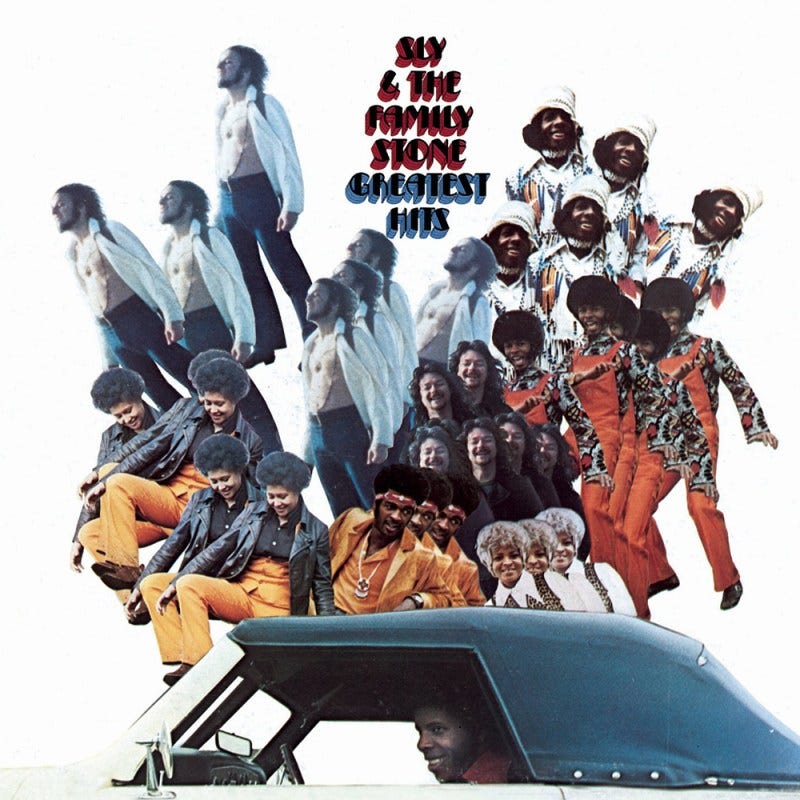
In 2020, in the depth of the pandemic, I took on a project of reviewing all 500 of Rolling Stone’s “500 Greatest Albums of All Time.” It was an excellent distraction from the state of the world at the time. I am making my way through the list again, from #500 to #1, this time sharing my reviews of each album.
Sly & The Family Stone, 1970
Sly & The Family Stone is, undoubtedly, one of the great rock bands of the 20th century, and two of their albums appear in the top 150 of the “500 Greatest Albums of All Time,” accordingly. This collection, released in 1970 in between studio releases, was their first #1 album and was one of the best-selling albums of all time.
The 60s and 70s were wild for albums. Sly and the Family Stone released four albums in 3 years, played Woodstock, and became a sensation. But when the fifth album was delayed due to Sly’s growing drug problems and declining mental health, the label decides to release a greatest hits package to fill the void. It is incredible to think that a band debuts in 1967 and by 1970 has a #1 album with their greatest hits.
Fortunately, there is no filler material here or additional unreleased tracks to pad the selection. It’s all hits, as advertised:
I Want to Take You Higher
Everybody Is a Star
Stand!
Life
Fun
You Can Make It If You Try
Dance to the Music
Everyday People
Hot Fun in the Summertime
M’Lady
Sing a Simple Song
Thank You (Falettinme Be Mice Elf Agin)
Why wouldn’t this be a #1 album? But I don’t see why this collection is any different than the other compilations I’ve already come across. If you create compilation albums of the greatest musicians of all time, of course they would be some of the greatest albums of all time. The deck is stacked.
Thus, my continuing pet peeve of this “Greatest Albums” list. Does a great compilation constitute a great album? Robert Christgau thought so, as in Christgau’s Record Guide: Rock Albums of the 70s he writes:
Sly & the Family Stone: Greatest Hits (Epic, 1970) As someone who was converted to Sly over the radio rather than at the Fillmore, I still have my doubts about his albums--even Stand! falters during “Sex Machine.” But this is among the greatest rock and roll LPs of all time.1
It gets an A+ as a great LP, but this was written in 1981, and maybe it doesn’t bother him that this was a company package rather than an artist-driven creative project. Maybe the intention isn’t the point, but the result is.
But Christgau would have had no inkling of the industry changes that would result from the advent of digital culture. An album released on vinyl in 1970 might have been equal to the studio releases that preceded it, but, in my mind, this is no longer the case. Streaming and playlists and Spotify changed the game. Access to great artists, especially those who mainly released singles, like The Ronettes, used to be limited. Music fans would buy the singles and then buy the LP that collected the singles. It was lucrative, and necessary. And in the case of Sly, it kept artists in the spotlight, lest a record company go 18 months without a release; in the 21st century, artists are releasing a song a month to keep the algorithms happy and they are never not in the spotlight. But I digress. Are compilations great albums?
I’ve not been able to convince myself yet through the 157 albums I’ve reviewed so far on the “500 Greatest Albums of All Time.” I still see the effort and intention of studio albums outweighing the act of merely collecting great songs (and there’s no question these are great songs). Albums capture moments in time, cementing for all time a creative direction, one vision. A playlist or greatest hits package doesn’t do that and may very well change over time. Many have.
My question maybe shouldn’t be “are compilations great albums?” but instead “does this compilation capture a moment in time?” In the case of Presenting the Fabulous Ronettes at #494 or Nuggets: Original Artyfacts From the First Psychedelic Era (#405), this is indeed the case - both of these capture something that didn’t exist before. This isn’t the case for The Anthology 1947-1972 (#483) from Muddy Waters or The Best of the Classic Years (#465) from King Sunny Ade. Both of these are examples of essential artists and important music but the collections themselves are arbitrary and evolving.

So: does Greatest Hits by Sly & the Family Stone capture a moment in time? Maybe to those who owned it at the time, but to me, this is another (great) collection of songs from an essential artist, and its inclusion on the list takes away from another album that might have been highlighted instead. The debate continues.
https://www.robertchristgau.com/get_chap.php?k=S&bk=70